Your runs. Your results.
The Dashboard brings together what your automations captured: text, files, screenshots, search results, and page metadata. Review it on this computer and download what you need.
Open the Dashboard
Click Dashboard in the side-panel header. It opens a full browser tab. You can also use View results in Activity or the Google Search worksheet’s View search results action to open retained results.
Create, edit, and run automations in the side panel. The Dashboard is where you browse their history and saved output. Open extension returns you to the panel.
Follow activity back to a run
All Activity combines runs, captured results, and downloads. Runs focuses on individual executions and their status. Open a run to inspect its files, datasets, per-link activity, and diagnostic logs. Search, filters, sorting, and pagination help you find an earlier capture. Wide tables scroll horizontally to reveal additional columns and actions.
Results retain their originating automation, run, time, and creating step where available. Editing an automation does not rewrite its historical results. Tests that save output appear as labeled Test runs.
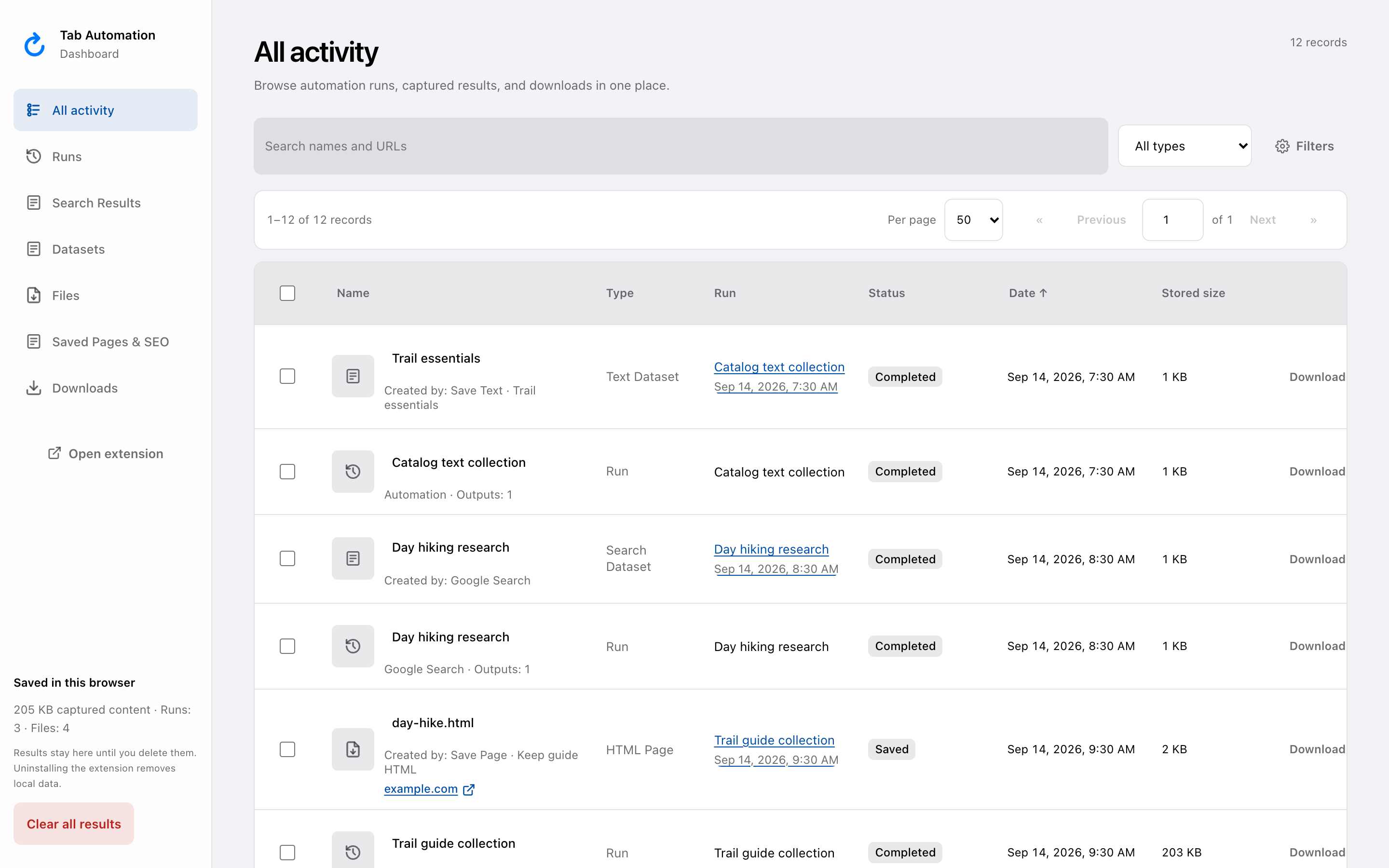
All screenshots show the real product with illustrative demo data. The search results are not a live ranking report. Open any image to inspect it at full size.
Review text as a dataset
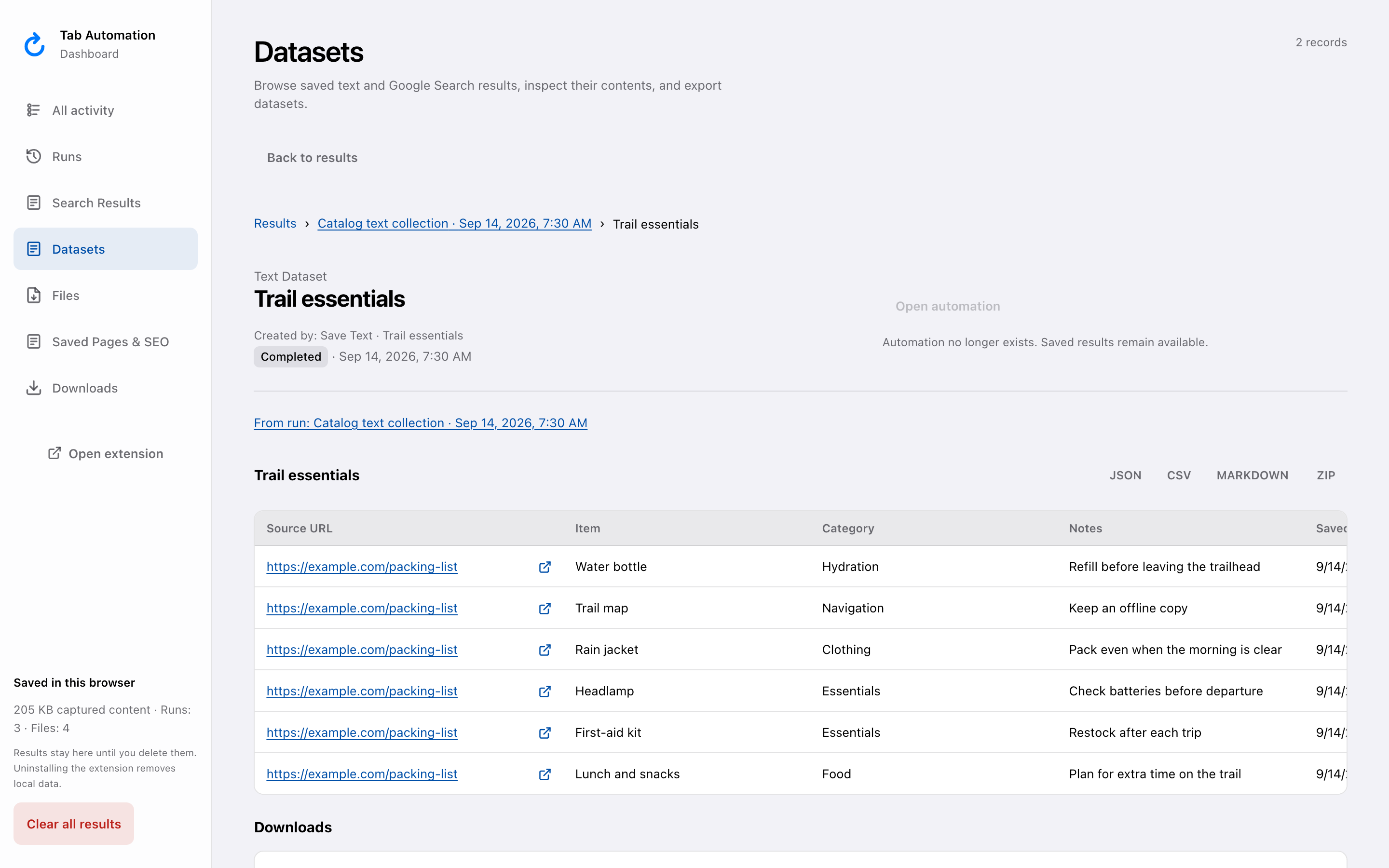
Save Text reads the fields you configure and appends one row per execution. Each Save Text step creates its own dataset within a run. Column names, source pages, and missing-field warnings stay with the rows.
Open Datasets to inspect saved text and Google Search results. Export text datasets as CSV, JSON, or Markdown, or include them in a whole-run ZIP. Dataset tables are for browsing; they do not edit the captured data.
Inspect saved files before downloading
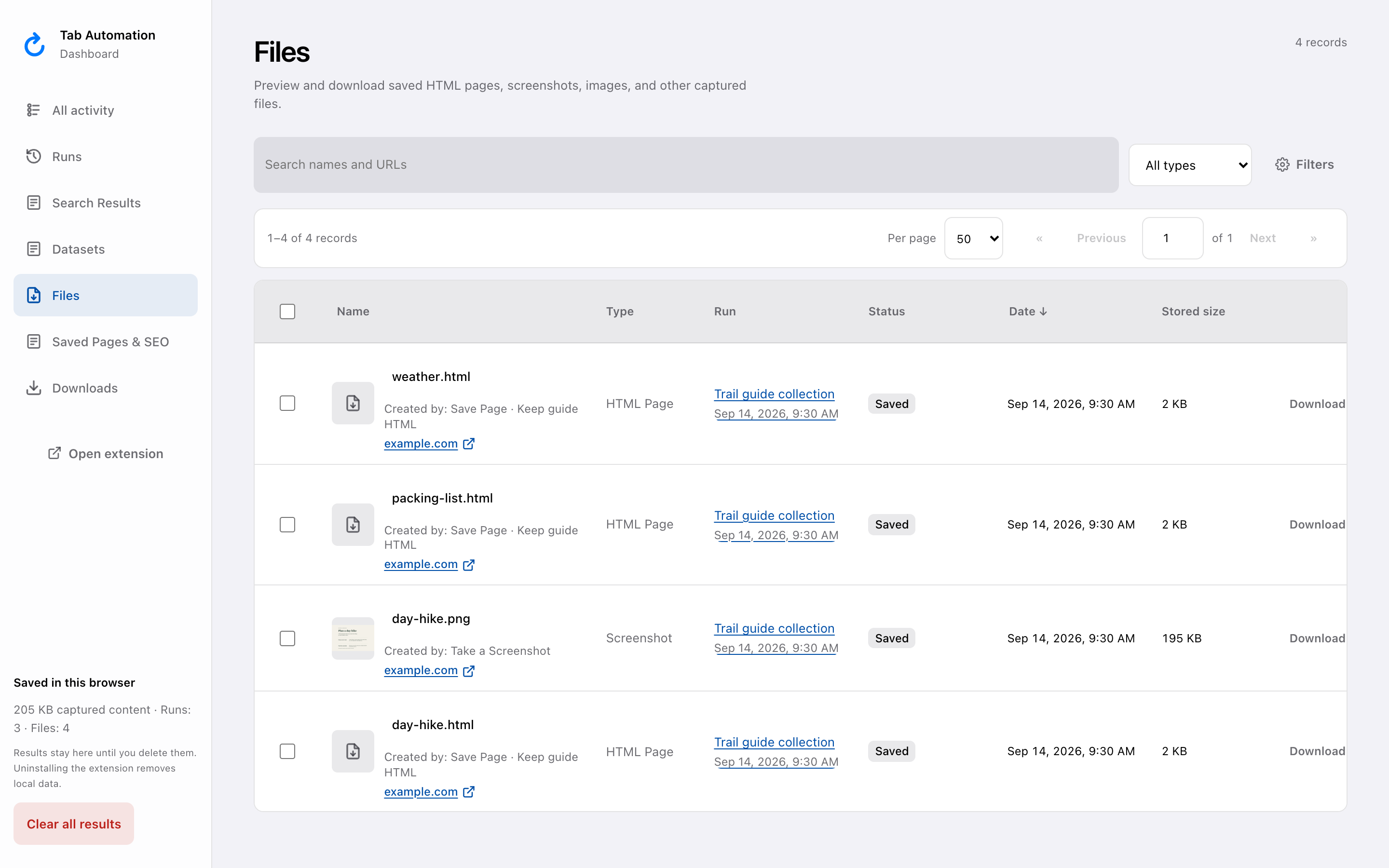
Files includes HTML pages, screenshots, images, and files captured by Download File. Preview images, open details for source and step information, and download one file or select several for a ZIP.
HTML previews show saved source as highlighted text. They do not render or execute the captured page. The preview displays up to 256 KiB; downloading the original retains its saved bytes.
Saving a file during an automation does not start a Chrome download. The export folder in Settings or on a step suggests the path used when you later download it.
Revisit a Google Search run
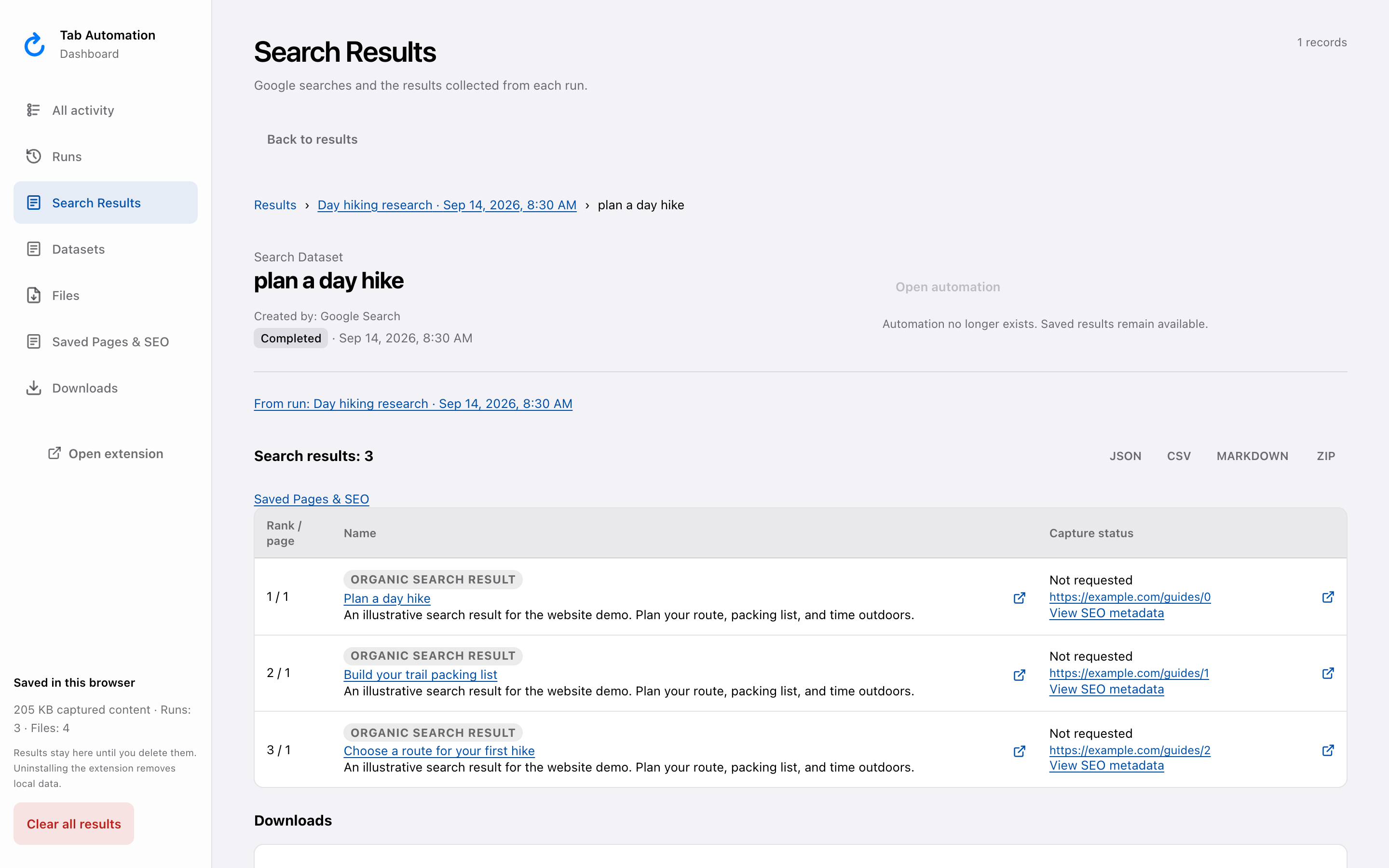
Search Results is the dedicated view for the Google Search workflow. Its datasets also appear in Datasets. Open a run’s results to review collected blocks, page-relative rankings, source capture status, and available retained content.
In the worksheet, New search accepts search terms or a supported Google results link and opens a new tab. Current search uses the active supported results page. View search results opens the retained dataset, including partial and failed runs.
Export JSON, CSV, research Markdown, or a ZIP. Markdown links observations to retained source text; it does not call a model or invent findings. The Saved Pages & SEO link scopes page metadata to that run, with a route back to the search results.
Explore Saved Pages & SEO
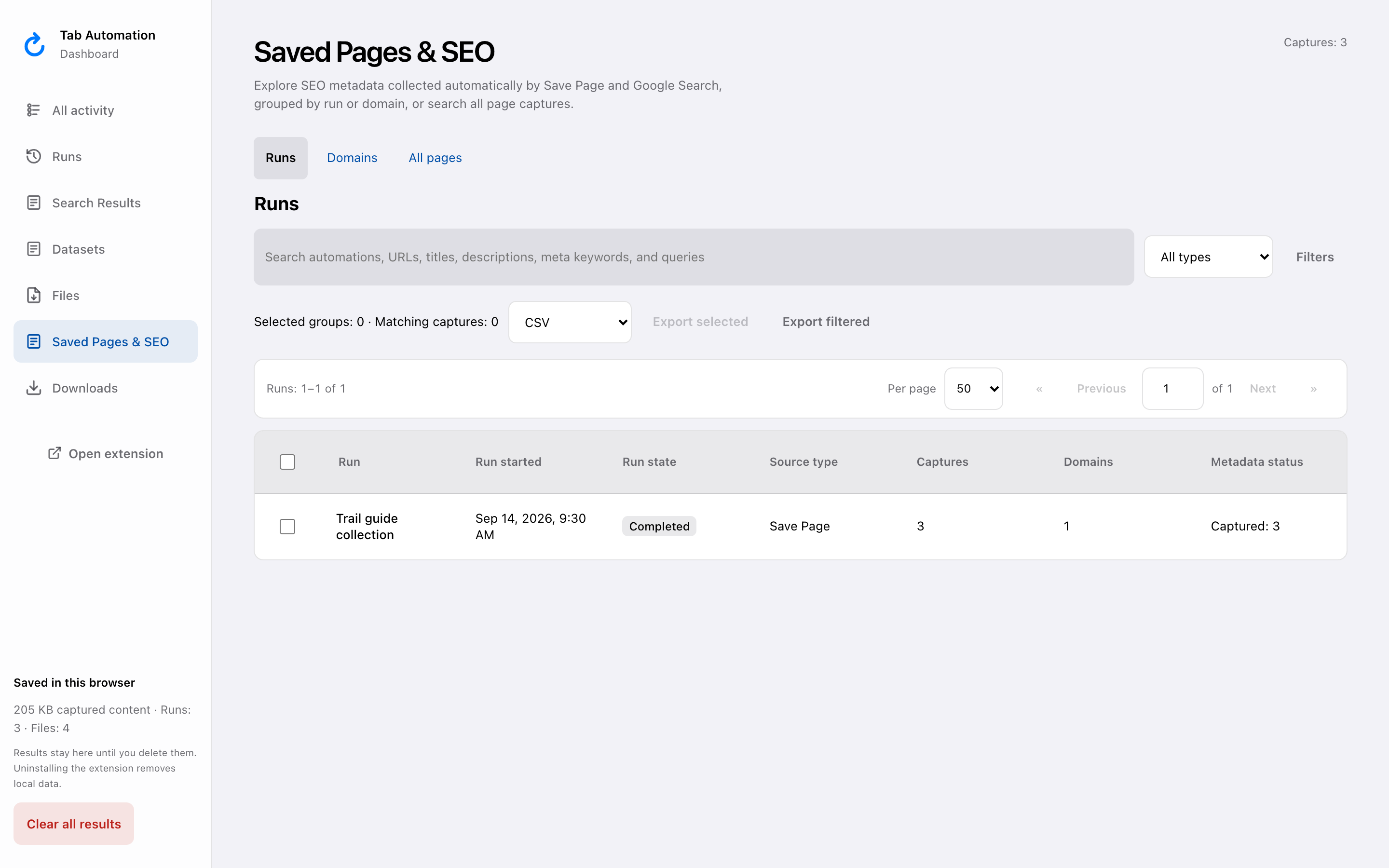
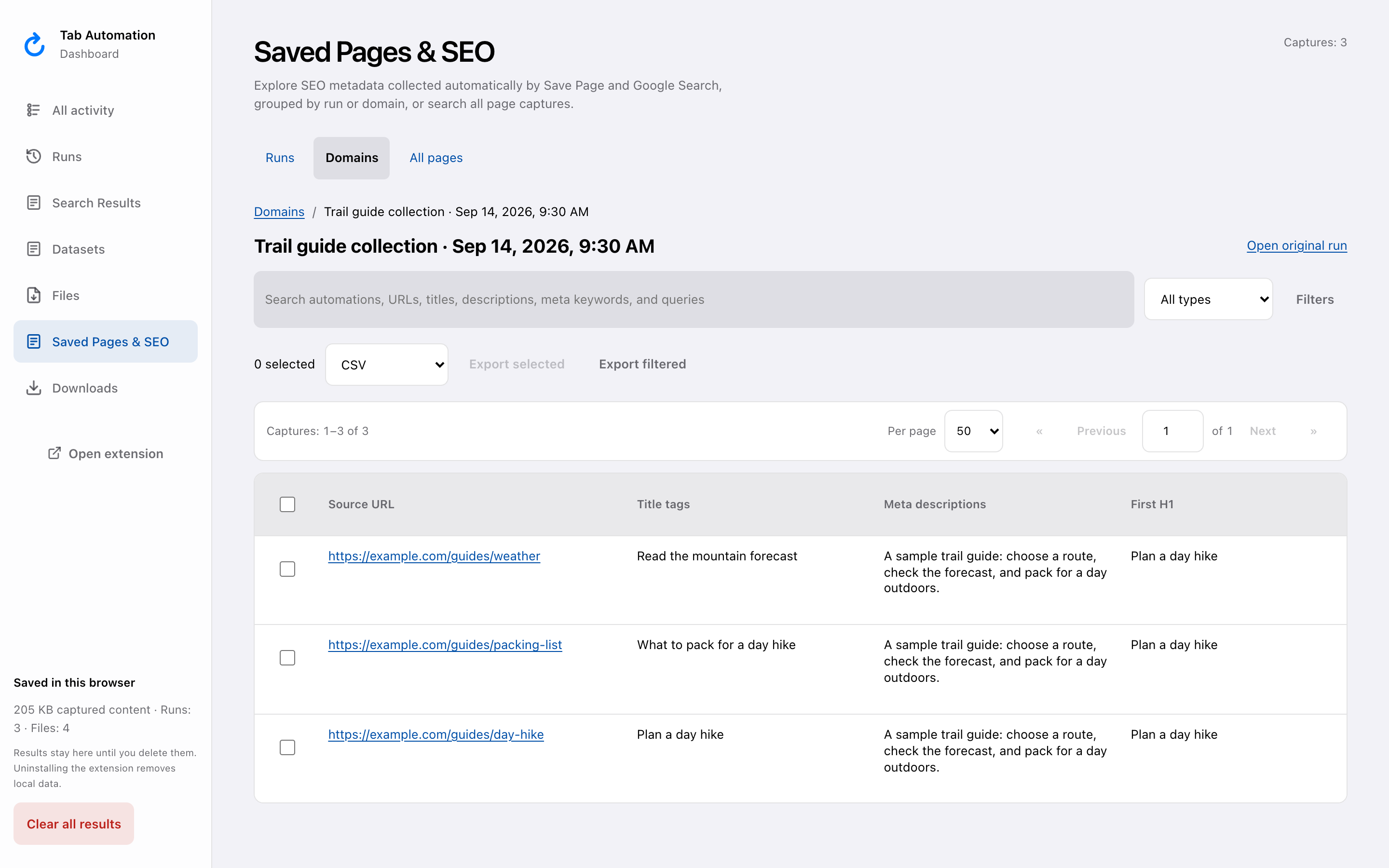
Save Page captures and enabled Google source visits collect on-page metadata automatically. Start with Runs, browse Domains → Runs → Pages, or choose All pages. Counts describe retained captures, so the same URL captured in different runs remains separate.
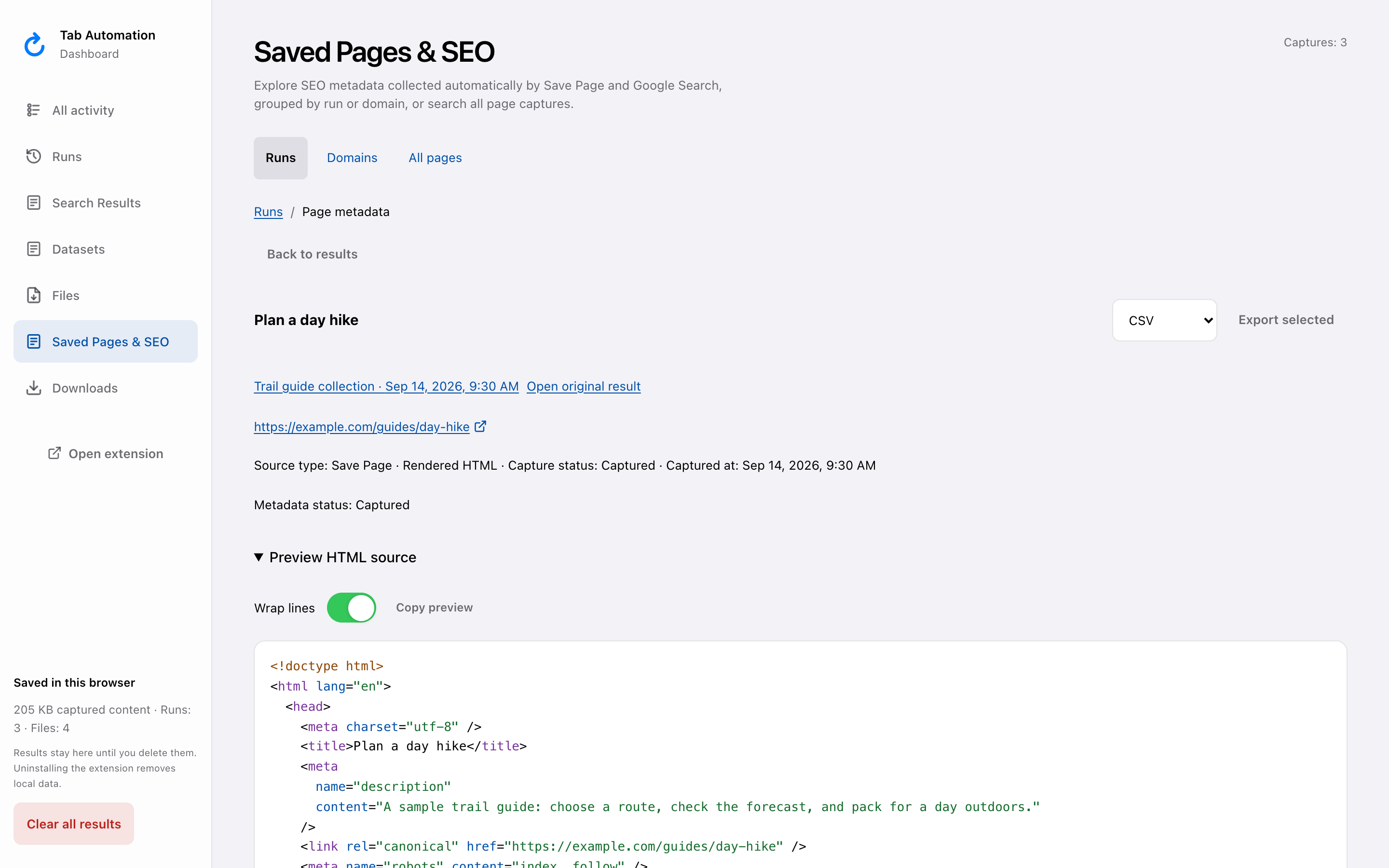
Open a page for title tags, descriptions, headings, canonical links, robots declarations, language, social tags, and declared structured-data types. Google’s result titles and snippets remain separate from the destination page’s metadata. These are captured declarations, without SEO scores, indexing verdicts, or structured-data validation.
Use Export selected or Export filtered for JSON, CSV, or Markdown reports. Filtered exports include matching captures across every page of results. Relevant ZIP exports also include SEO reports.
Inspect retained HTML and retry metadata
Expand Preview HTML source when a saved capture is available. Retry metadata inspection retries one failed or unavailable inspection; Retry failed inspections works across a run. Retries use retained HTML without requesting the live page. Missing HTML cannot be retried, and a truncated capture remains partial.
Saved HTML inspection reads at most 16 MiB, has a 10-second parser timeout, and retains up to 256 KiB of metadata. Capture and inspection limitations remain visible. A retry continues if you close the Dashboard; use Cancel to stop it.
Export when you are ready
Finish or pause a running run before exporting its retained output. An export of a paused run captures what has been saved so far and stays labeled partial. Resuming the automation does not change that export’s snapshot.
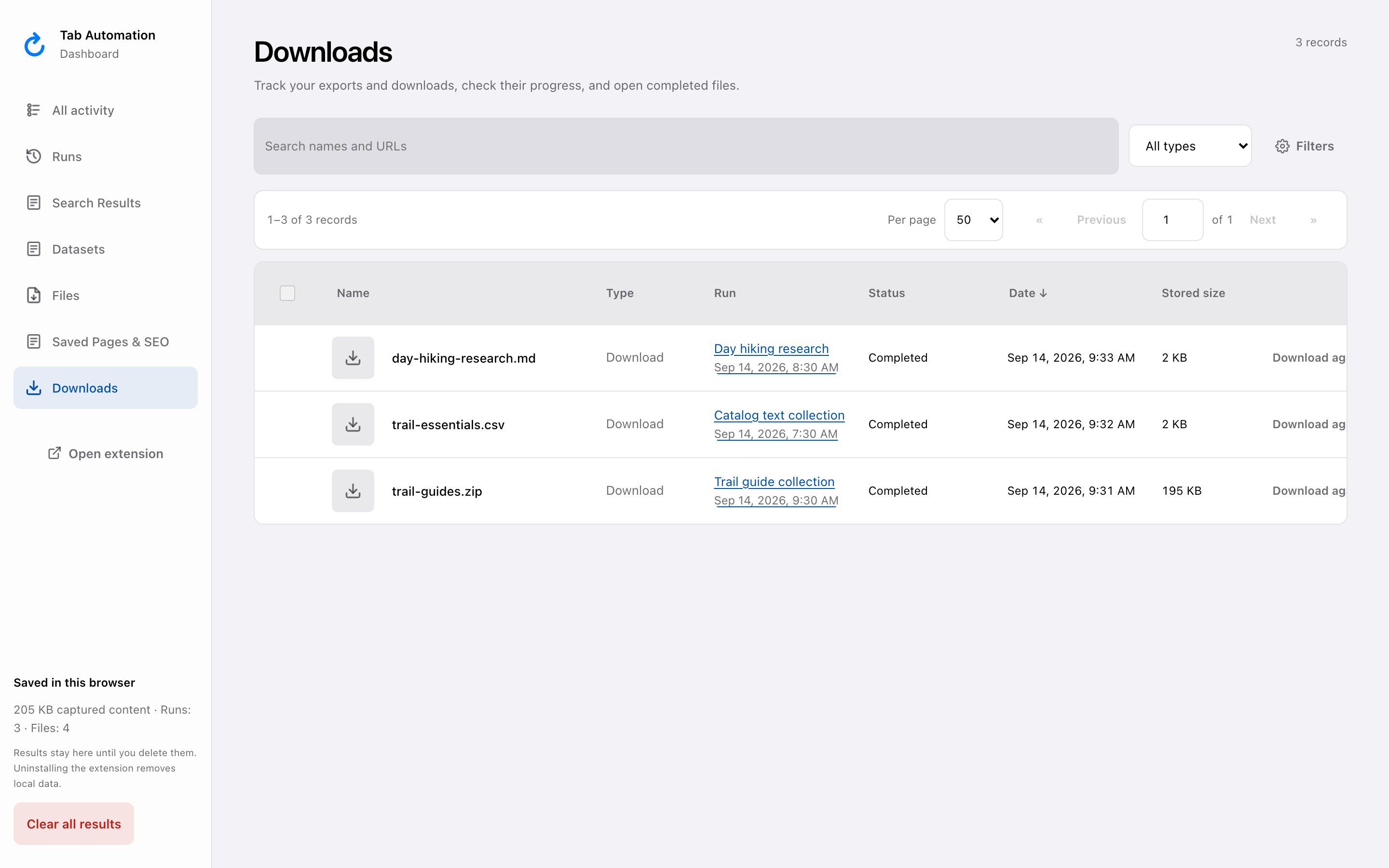
Downloads tracks preparation, download progress, completion, and errors. Use the available cancel or retry actions when needed. A retry or download-again action creates a new export from the currently retained originals.
Saved on this computer
Results remain in extension-owned local storage until you delete them. Rerunning or removing an automation preserves its retained history and output. Deleting a run removes its owned results; deleting one dataset preserves sibling datasets and files. Clear controls explain which retained records will be removed.
Uninstalling the extension or clearing its storage removes local results. Downloaded copies remain independent. Temporary export files are cleaned after completion or cancellation; download history remains until cleared.
Storage failures pause the affected save. Review the reported cause, free space if needed, and retry from the side panel. Successful earlier steps are not replayed. There is no cloud or device sync. See Privacy for storage, page access, license checks, and webhooks.
Start with the steps reference, the side-panel tour, or the Changelog for recent additions.